Last reviewed: October 25, 2026. Bybit TradFi products do not all trade 24/7. Trading hours, fees, leverage and overnight charges depend on the exact contract and account region. Identify the product first, read its current symbol specification, and convert the dated session from server time before interpreting an NVIDIA- or Nasdaq-linked quotation.
Affiliate and risk disclosure: ByDITT is independent from Bybit. The BYBITDC link is an affiliate link and may compensate ByDITT. It does not guarantee account approval, a fee discount, or trading results. TradFi products offered through Bybit can be leveraged CFDs or other derivatives rather than shares in the underlying company. Leverage can magnify losses and may lead to liquidation.
Key facts before trading
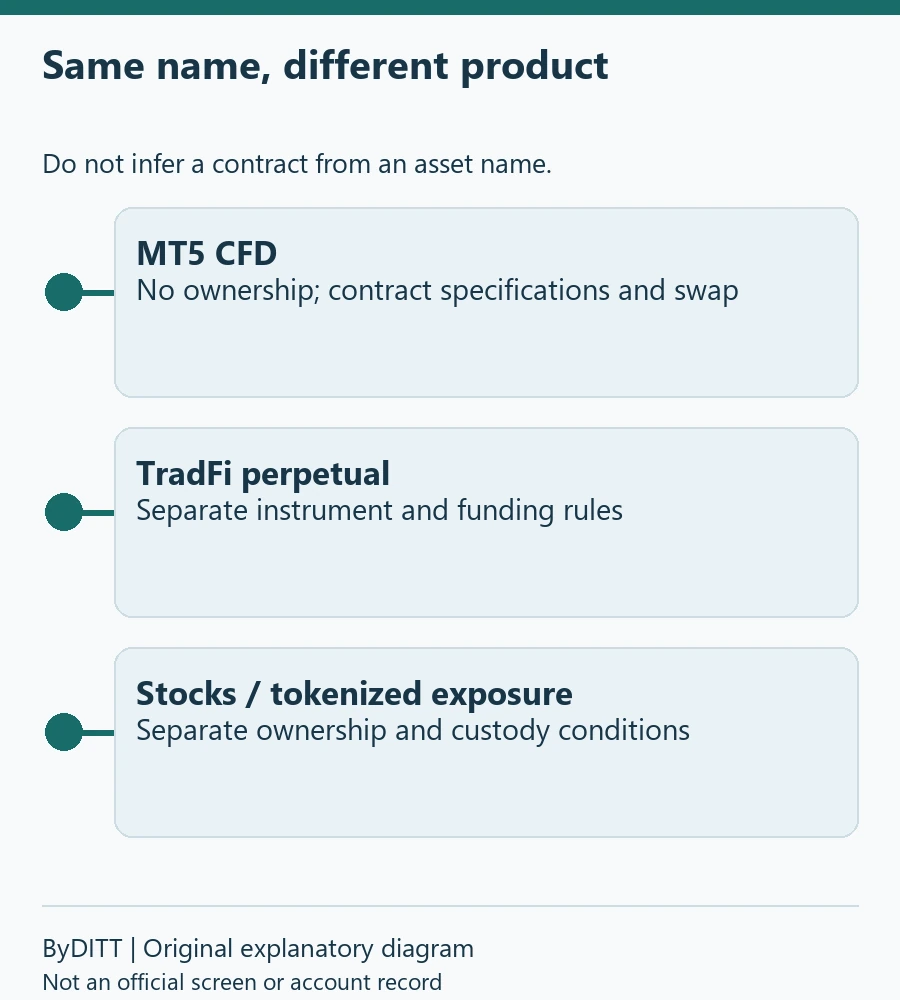
- There is no universal TradFi trading timetable. MT5 CFDs, TradFi perpetuals and stock or tokenized products have separate rules. A product name or an old 24/5 label is not evidence of the current session for an NVDA- or Nasdaq-linked instrument.
- An NVDA CFD is not an NVIDIA share. It is a contract whose price references the underlying market, subject to the platform’s contract specifications.
- “Nasdaq” can refer to different instruments. Confirm the exact symbol, contract type, quote currency, tick size, leverage, and expiry or rollover rules.
- Costs can include more than commission. Spread, swap or overnight financing, conversion, and liquidation costs can exceed the headline trading fee.
What Bybit officially says about TradFi availability
Bybit’s current Introduction to CFD describes the MT5 CFD product and its Zero-Fee and Tight-Spread modes. This is not a specification for every product described as TradFi. A CFD is a leveraged derivative rather than ownership of the underlying share; a perpetual contract has separate funding and trading rules.
The former 24/5 stock notice and former contract-specification URL used in this article were not available at this review. Their absence does not prove that a particular product has ceased trading. Use Bybit’s current CFD instrument-information procedure and the dated Info or Specification panel for the exact symbol. Weekday access, where offered, is not continuous weekend trading.
NVDA-linked products: confirm what you are buying
A product carrying “NVDA” in its name may track NVIDIA’s share price, but a CFD does not give voting rights, dividends on the same legal basis as a shareholder, or ownership of a share held at a securities broker. The platform’s adjustment and corporate-action rules control how dividends, splits, and market closures are reflected.
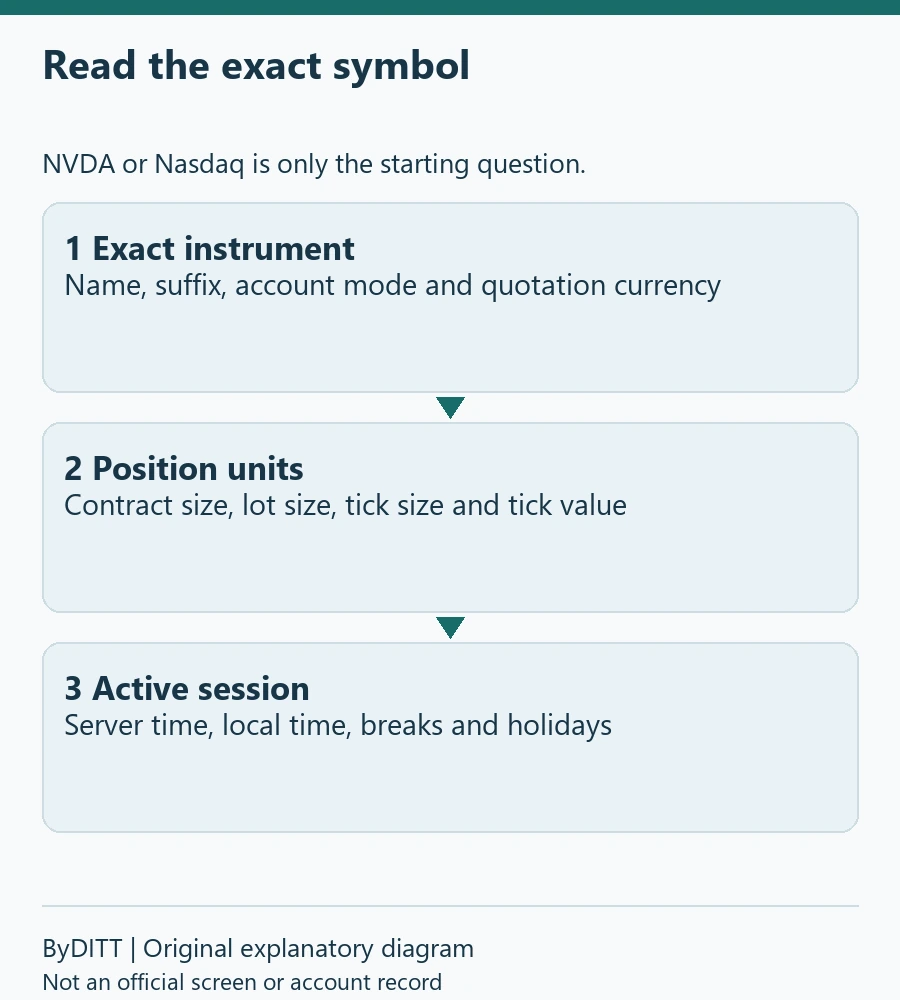
- Open the instrument’s Info or specification panel.
- Record the symbol, contract size, minimum lot, tick size, margin requirement, and maximum leverage.
- Check whether the quote is indicative while the underlying market is closed.
- Review overnight swap and weekend charging rules before holding the position across sessions.
- Confirm how corporate actions and trading halts are handled.
Nasdaq-linked products: do not rely on the label alone
“Nasdaq” may describe an index-linked CFD, an exchange-traded futures reference or another derivative. Bybit’s official indices guide uses NAS100 as a CFD example; this does not make NAS100 an exchange-listed Nasdaq futures contract. Verify its current suffix, lot and tick values in the live Info panel. The exact NVDA-linked symbol, contract size and session available to a particular account were not independently verified for this article, so no current NVDA specification or weekend availability is asserted.
| Item | Why it matters |
|---|---|
| Trading session | Orders may be rejected, queued, or exposed to a gap outside the active session. |
| Contract size and tick value | A small price move can produce a larger gain or loss than expected. |
| Margin and leverage | Determines how quickly adverse movement can trigger a margin call or liquidation. |
| Expiry or rollover | Can create a forced close, price adjustment, or financing difference. |
| Swap schedule | Holding overnight can create a daily charge, and a three-day swap may apply on a specified day. |
Trading hours: 24/5 is not 24/7
Market availability should be checked in the account at the time of trading. Holiday schedules, daylight-saving changes, maintenance, and extraordinary halts can change the normal session. A price displayed while the underlying market is closed may not represent executable liquidity at the same spread.
- Open the TradFi or MT5 symbol list in your account.
- Select the exact instrument and open Info or Specification.
- Confirm the server time zone and convert it to your local time.
- Check daily breaks, Friday close, Monday open, and the current holiday notice.
- Recheck the session immediately before a time-sensitive order.
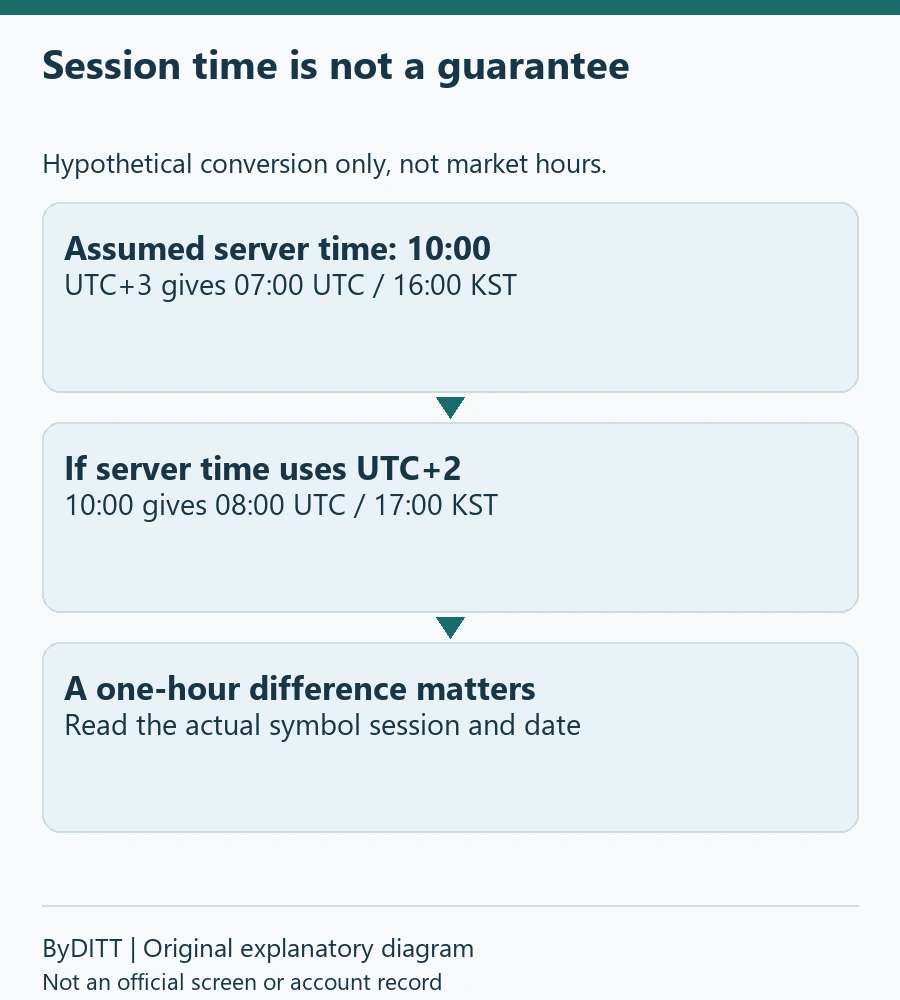
Hypothetical time conversion: if a displayed session starts at server 10:00, UTC+3 gives 07:00 UTC / 16:00 KST, whereas UTC+2 gives 08:00 UTC / 17:00 KST. These are arithmetic examples, not opening hours. The official setup guide describes server offsets of GMT+2 or GMT+3 depending on daylight saving; confirm the actual session date, holiday notice and current server offset rather than applying one offset all year.
Understand every cost, not only the headline commission
Bybit’s CFD Fees Explained distinguishes account-mode, product and holding-cost conditions. An advertised commission rate is not the whole trading cost. The exact symbol and Zero-Fee or Tight-Spread mode matter; a different TradFi product may use a different fee or funding system. The total cost can include:
- Spread: the difference between the available buy and sell price.
- Commission: a charge based on the product’s fee rule and traded amount.
- Swap or overnight financing: a debit or credit for holding across the designated rollover time.
- Currency conversion: a potential cost when account and instrument currencies differ.
- Slippage: execution at a different price during fast or thin markets.
- Liquidation cost: a forced close can occur before the underlying market returns to your expected price.
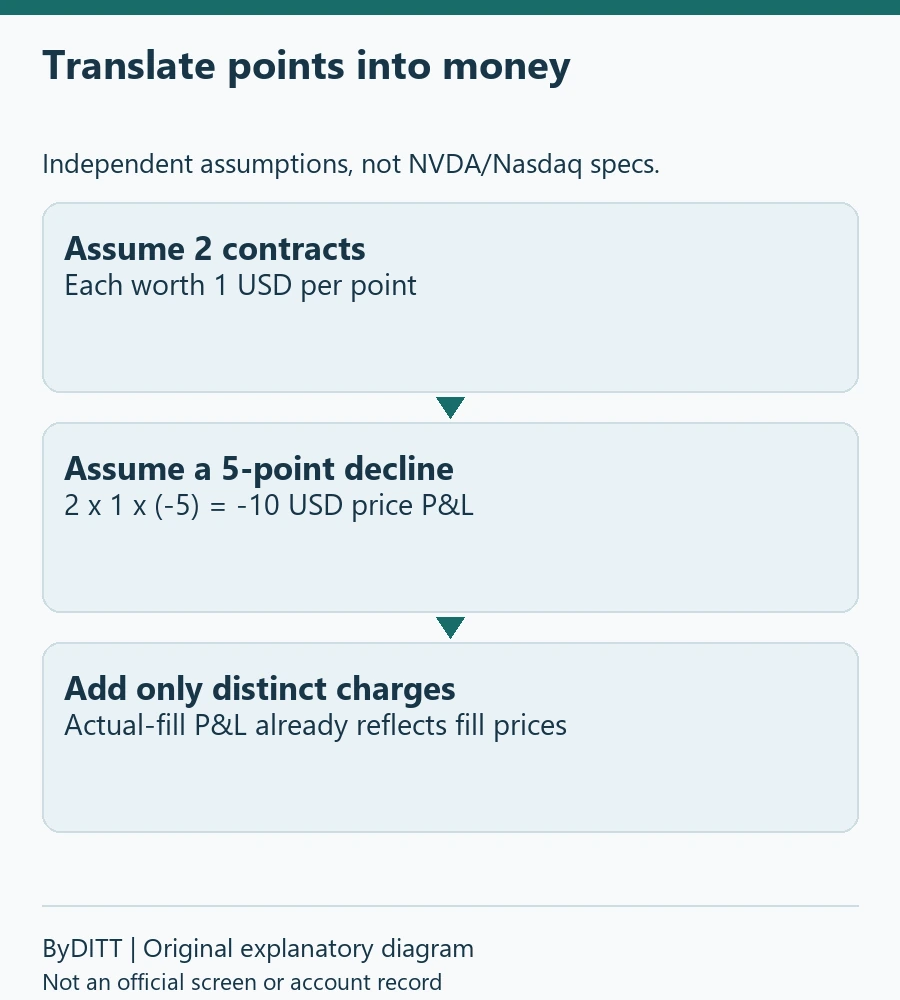
From points to money — assumed example: 2 contracts × 1 USD per point × (−5 points) = −10 USD price P&L. The contract count and USD-per-point value are independent assumptions, not live NVDA or NAS100 specifications. Bybit’s CFD slippage example shows a NAS100 quote of 21200 and execution at 21205: a 5-point difference, not automatically a 5 USD charge. The cash effect depends on direction, quantity and the contract’s point value.
When reconciling actual entry and exit fills, their price P&L already incorporates the executed prices. Add distinct recorded commission, swap and conversion charges; do not subtract spread or slippage a second time. For a fuller worked cost reconciliation, see the ByDITT TradFi cost guide.
A claimed referral benefit should be verified separately from these costs. Even when an account receives an eligible fee benefit, it does not remove spread, swap, slippage, or market loss.
Risk controls for session-based leveraged products
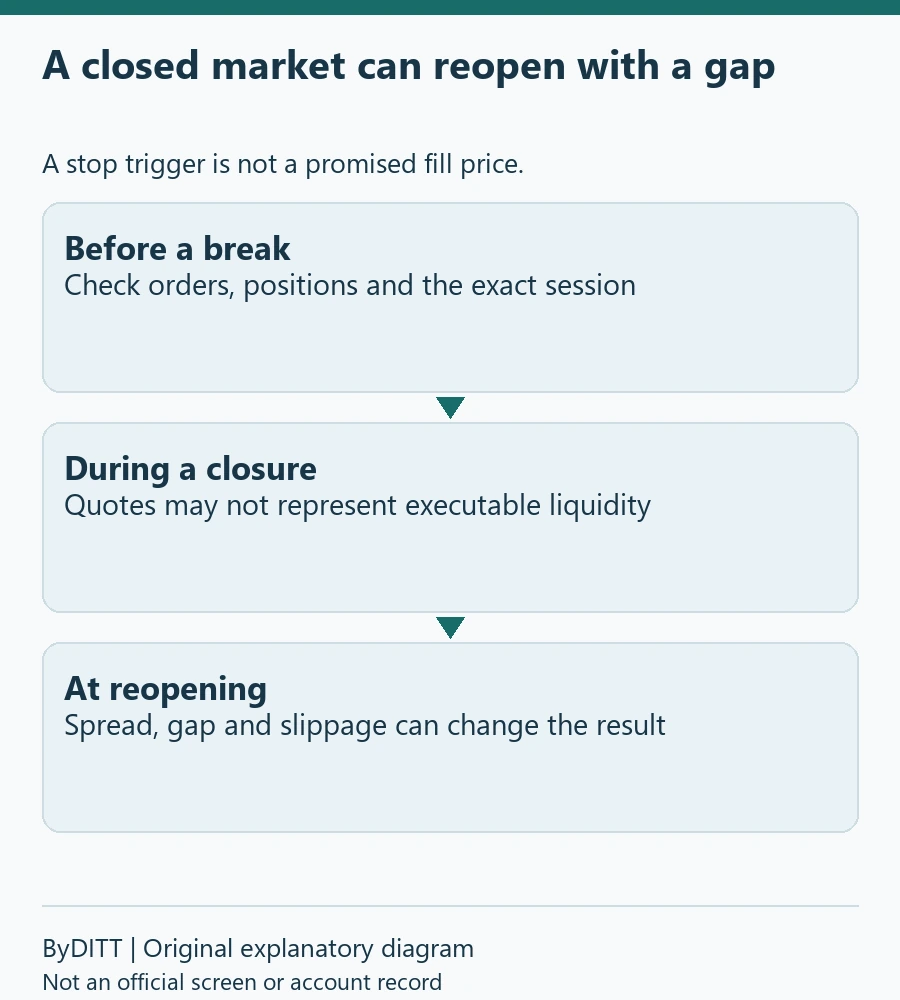
- Use the stop distance only as a planning assumption, not as a maximum-loss guarantee. Gaps, slippage or an unfilled stop-limit order can make the realized loss larger.
- Allow for gaps across session breaks and weekends; a stop order cannot guarantee its trigger price.
- Avoid holding through earnings, major economic releases, or holidays unless the gap risk is intentional.
- Keep unused margin so a small adverse move does not trigger liquidation.
- Review correlated exposure: an NVDA-linked position and a Nasdaq-linked position may concentrate the same technology-sector risk.
- Use read-only API permissions if you connect analysis tools; never enable withdrawals for a trading dashboard.
A practical pre-trade checklist
| Check | Evidence to save |
|---|---|
| Exact instrument | Symbol and specification screenshot |
| Session | Current trading hours and holiday notice |
| Cost | Spread, commission, swap, and conversion rules |
| Risk | Position size, margin, liquidation level, and stop plan |
| Account terms | Region, KYC status, and product eligibility |
Using BYBITDC
If you choose the affiliate link, verify any displayed benefit during registration and then check your account’s fee page. The code does not change market hours, product specifications, spread, swap, liquidation risk, or regional eligibility.
Frequently asked questions
Can I trade NVIDIA on Bybit all weekend?
Do not assume weekend availability. A 24/5 description, where applicable, is not 24/7, and it does not establish the live session for a particular NVDA-linked symbol. Read that symbol’s current specification and holiday schedule. MT5 CFDs and TradFi perpetuals must not be treated as the same product.
Is an NVDA CFD the same as owning NVIDIA stock?
No. A CFD is a derivative contract. It does not create the same ownership and shareholder rights as a share held through a securities broker.
Does a fee discount remove overnight costs?
Not necessarily. TradFi commission, spread, and swap rules are separate. Check each charge in the instrument specification and your account.
Official references
- Introduction to Bybit CFD
- Slippage in CFD Trading
- CFD Instrument Information and Specifications
- CFD Fees Explained
This article is educational and does not provide investment, tax, or legal advice. Availability, tax treatment, and product rules depend on your jurisdiction. Leveraged trading can result in rapid and substantial loss.