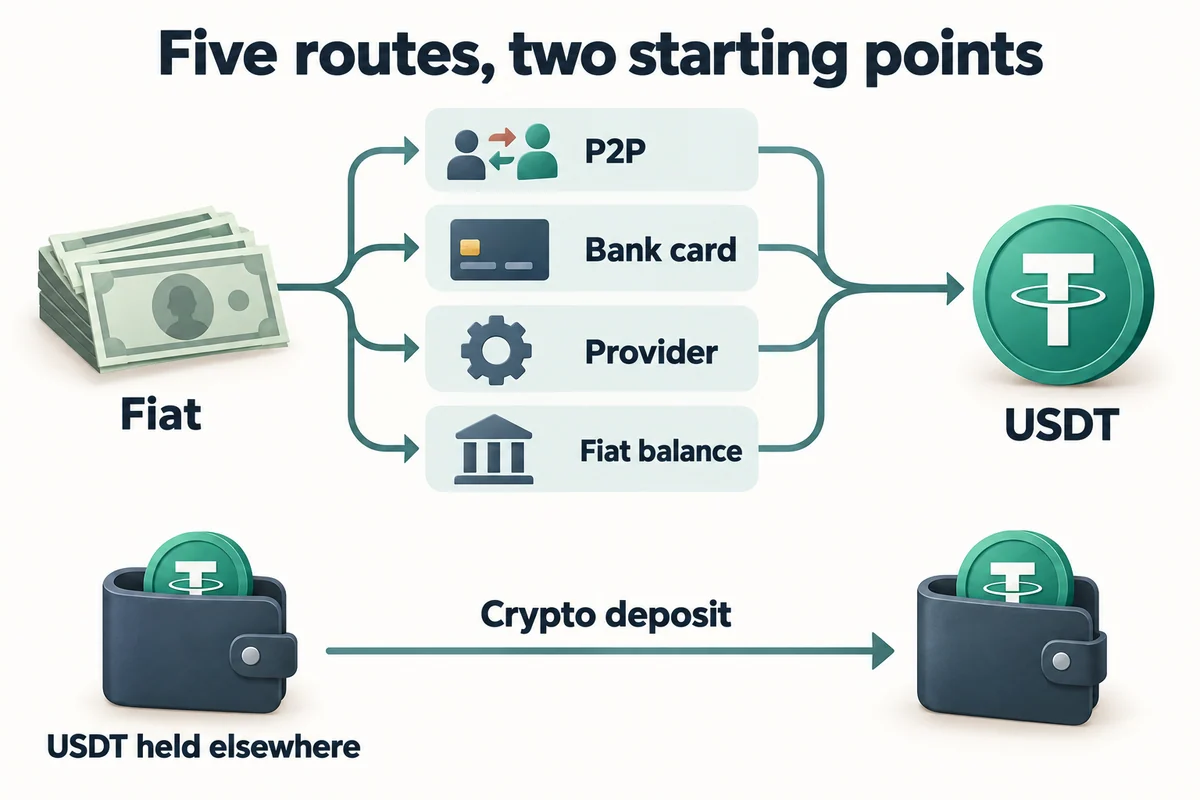
To buy USDT on Bybit, compare the methods actually available to your account: P2P, an external bank card, a third-party provider or an existing fiat balance. If you already own USDT, a crypto deposit moves it rather than buying it again. Compare total money debited with final USDT credited, not a headline fee percentage, and rule out unavailable or unsuitable routes first.
Last checked: October 18, 2026. This is an educational comparison, not a live purchase test or a recommendation to register, deposit or trade. All calculation inputs below are assumed, not current quotes. Illustrations are original AI-assisted explanatory graphics, not official service interfaces.
Affiliate disclosure: ByDITT is an independent educational and affiliate site, not Bybit.com. This page includes one affiliate link associated with code BYBITDC; ByDITT may receive compensation from eligible activity. The code does not establish a universal discount, purchasing fee, reward or regional eligibility.
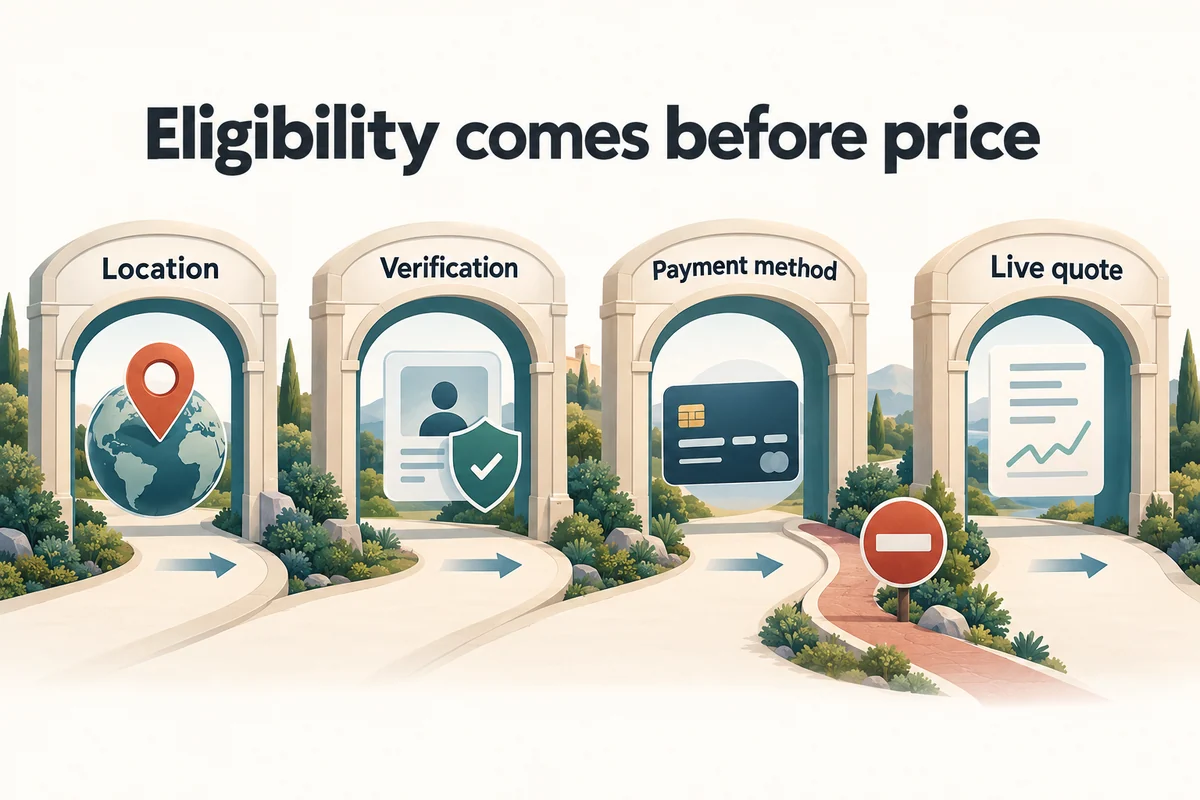
1. Check eligibility before comparing a quote
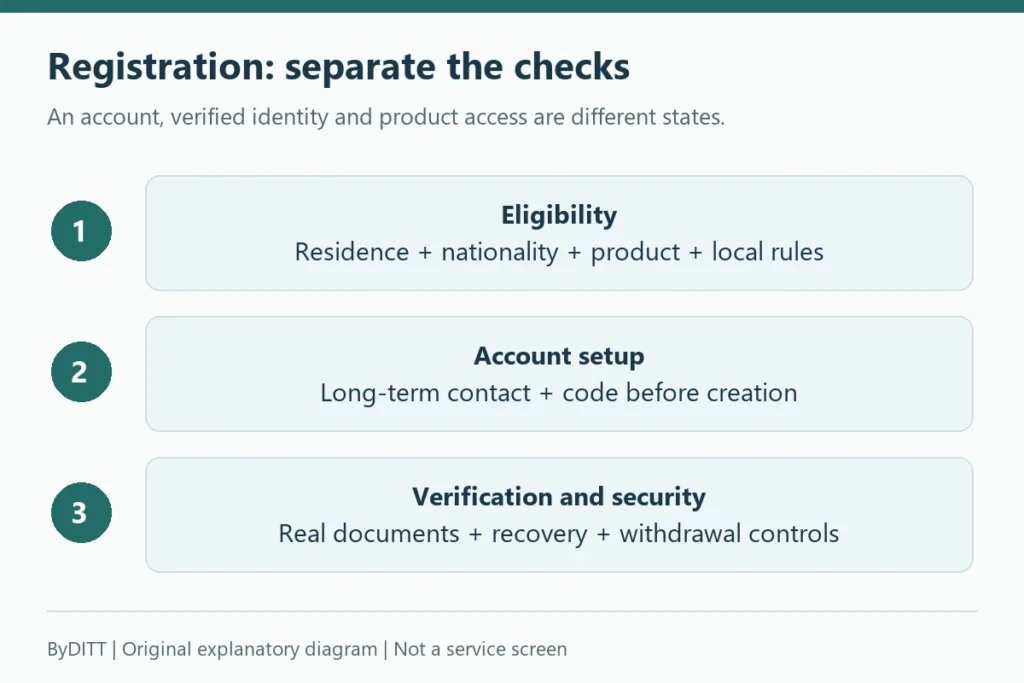
A price is useful only if you can use the route lawfully and complete its requirements. Check your actual residence, the legal entity serving the account, supported currencies and the provider. A language option, successful registration or referral code is not proof that every product is available.
- Location: review Bybit’s restricted-jurisdiction information and applicable local rules. Do not use false residence details or a VPN to circumvent restrictions.
- Identity and account type: the One-Click Buy FAQ requires individual identity verification and says subaccounts are not supported. Standalone P2P has its own verification rules, including documented Business KYC support. Do not transfer one channel’s rules to another.
- Payment account: confirm your bank, card or wallet can make the intended payment in your own verified name. An issuer can decline a transaction even when the exchange shows the method.
- Limits: use the order’s minimum, maximum, remaining limit and additional verification request. A table for another currency or account is not a promise.
For preparation rather than purchase pricing, see the registration, KYC and security checklist and country eligibility guide.
2. Five routes with different starting points
| Route | What happens | Costs to compare |
|---|---|---|
| P2P | Fiat paid to another user; crypto released through the order system | Advertiser price, applicable platform fee, bank/wallet charges |
| External bank card | Card payment for a crypto purchase | Quote, service fee, issuer FX/other charges |
| Third-party provider | External company handles payment and verification | Provider quote, fee, issuer charges and delivery terms |
| Fiat balance | Fiat deposit followed by USDT purchase | Deposit and conversion legs |
| Crypto deposit | USDT already owned moves to the account | Sender withdrawal/gas cost, plus acquisition cost if buying elsewhere first |
Route A: P2P—price and order conditions both matter
A buyer reviews an advertisement’s price, amount range and payment method before following its order process. Fiat payment and crypto release are separate events. A good-looking price is not enough if the payment account, time window or conditions cannot be met.
P2P is not universally fee-free. The current currency-specific fee schedule distinguishes maker/taker roles, currencies and verification conditions. It lists a 0.25% taker rate for relevant AZN pairs and certain Azerbaijan-verified USD/EUR trades; currencies not listed have no transaction fee under that schedule. Banks and wallets may charge separately. This specific schedule matters when an older general overview says zero transaction fees.
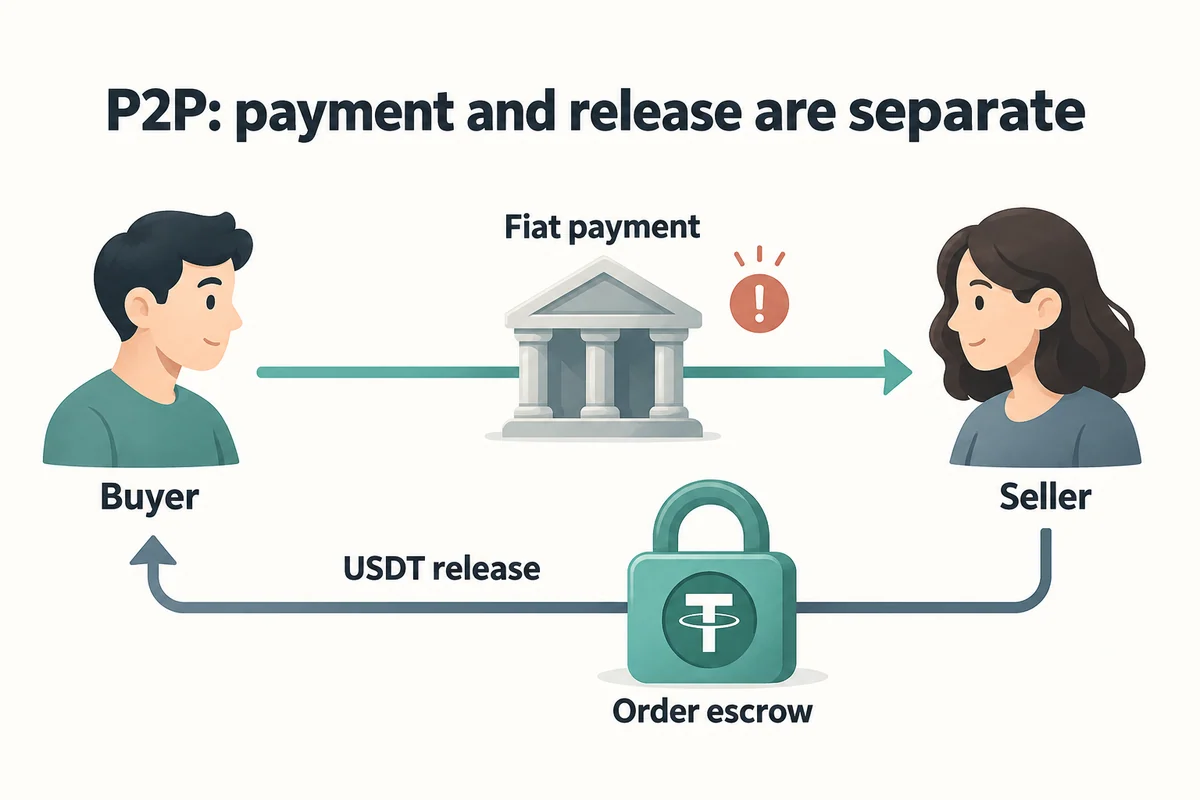
Compare all fiat leaving your bank with the USDT shown as receivable. Stay within the official order process and preserve payment evidence. After payment, inspect that existing order and its appeal options rather than treating a request to cancel or pay again off-platform as routine. Use the P2P payment-safety and appeals guide for detailed procedures.
Route B: an external bank card—not the Bybit spending card
Buying crypto with a card issued by your bank is different from spending a balance with the Bybit Card. Its ATM and spending-conversion fees are not the purchase fees for this route.
The bank-card purchase schedule, updated October 13, 2026, lists 2.10% for Visa/Mastercard issued in its specified European country group and 3.70% for “Others.” Those entries do not prove any particular card or country is eligible. Do not treat them as a universal EU/EEA rate or reuse an old 1.1% example as today’s general rate. Issuer currency-exchange charges can apply in addition.
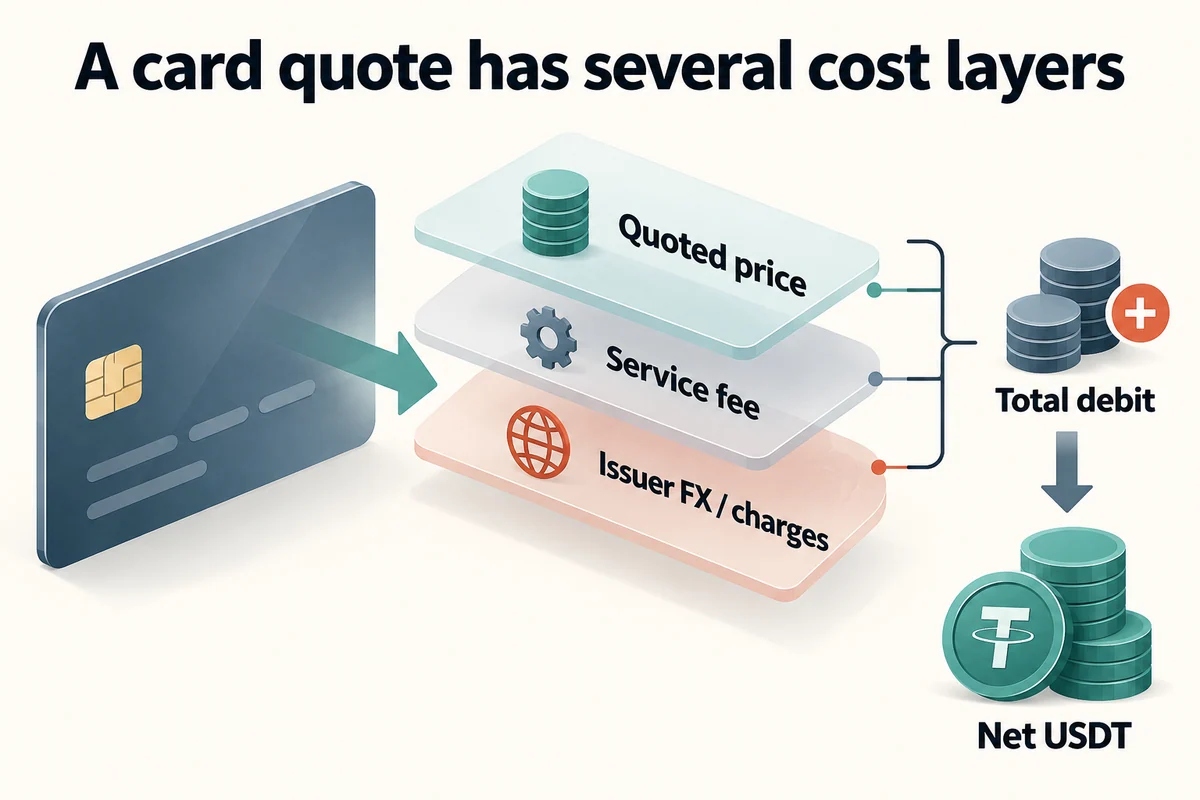
Distinguish the purchase principal, service fee, debit currency and USDT receivable. The card-payment FAQ also directs users to payment details because fees vary with fiat currency. Ask the issuer about charges outside that preview. A low exchange-side fee is not a complete quote if your card bills in a different currency.
Do not guess the deduction convention. Subtracting a fee already included in the final receive amount counts it twice. If it is added on top, entering your full budget as purchase principal can exceed your intended total debit.
Route C: third-party providers—keep two records
A provider route can redirect you to a separate service for payment and its own verification. Its quote, terms, support and refund process may differ from the exchange’s. Record both the provider order ID and the receiving account’s credit status. A bank debit alone does not establish that the exchange credited USDT.
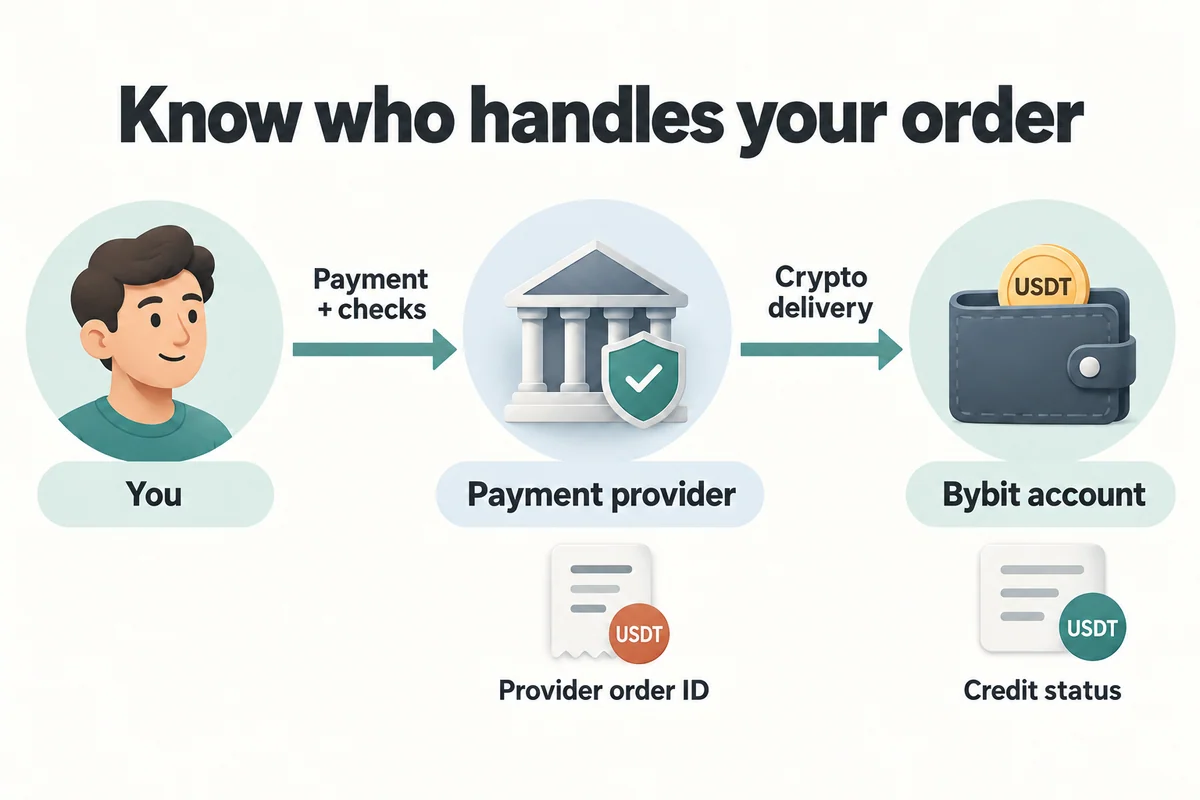
Bybit’s funding-method overview describes provider-side verification and delivery after the provider completes an order. Compare the final coins and total debit, and identify who handles a failure. No historical zero-fee campaign is assumed to remain active or apply to you.
Route D: fiat balance—check both steps
Where supported, fiat is deposited first and then used to buy crypto. A completed fiat deposit is not a completed USDT purchase. Keep the bank/payment deposit record separate from the conversion record.
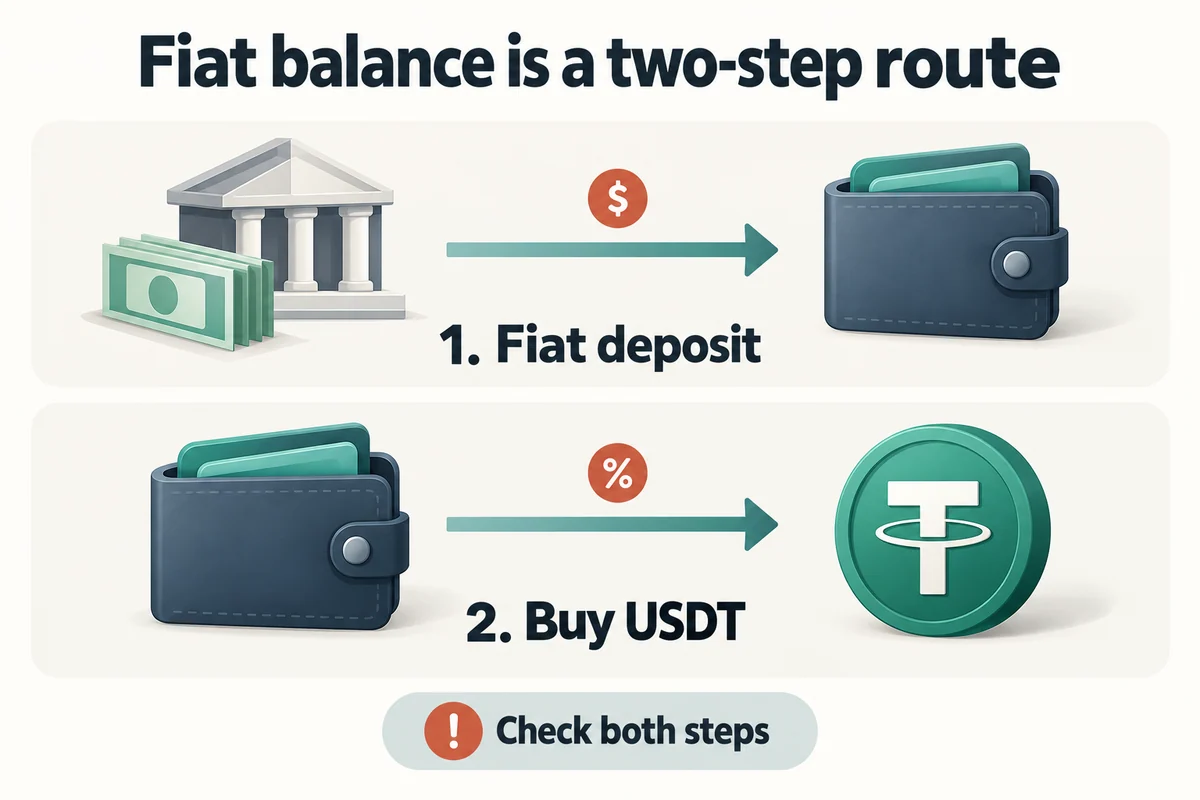
The funding overview says the fiat-balance purchase option requires a first fiat deposit and linked two-factor authentication. Review the deposit method’s fee and the later conversion quote; neither step should be assumed free. Regional and currency support can make this route unavailable even if another person can see it.
Route E: crypto deposit—include what happens before the transfer
Bybit’s general fee overview says it does not charge for on-chain crypto deposits. The full journey can still cost money: a sending exchange may charge a withdrawal fee, while a self-custody wallet may require network gas. Do not add the same network cost again when the sender’s fee already includes it.
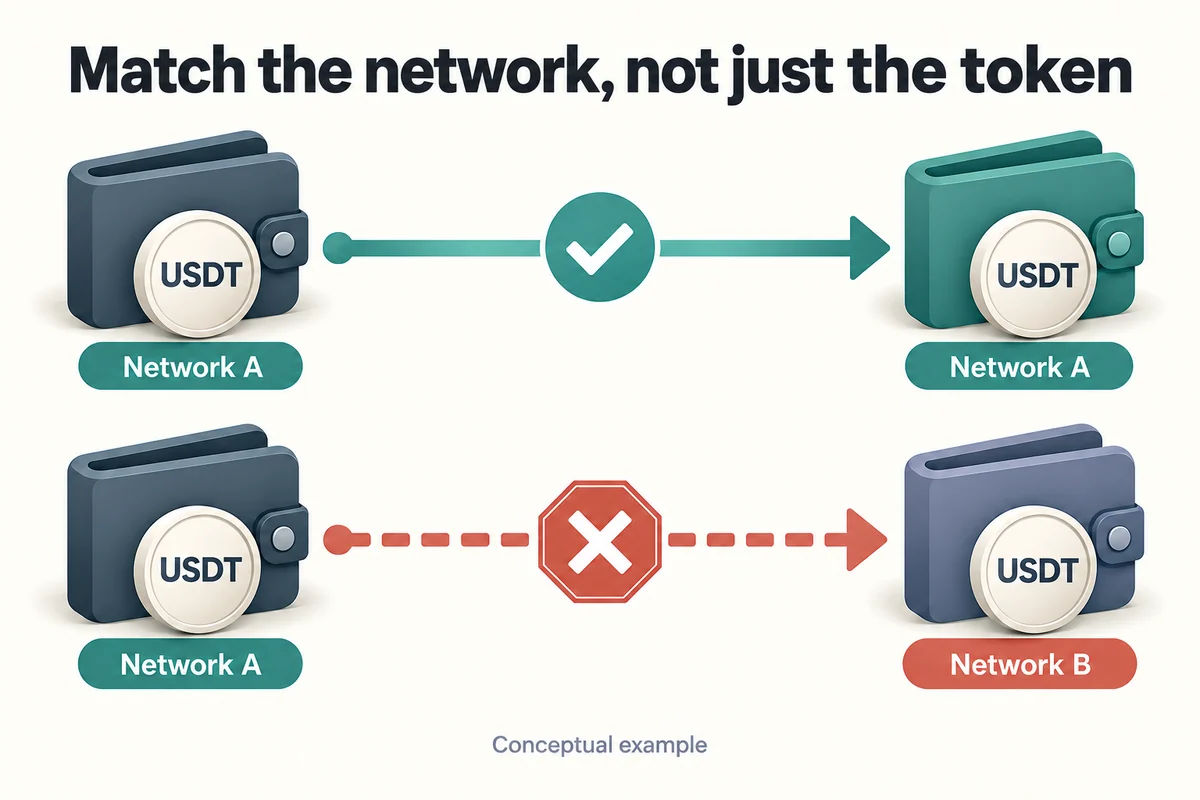
If you already own USDT, compare the incremental transfer cost. If you only own fiat, include the purchase elsewhere and the transfer. If you send another asset and convert it afterward, include that conversion and its price exposure. These starting positions are not interchangeable zero-deposit-fee scenarios.
Match the exact supported asset and network at both ends, retrieve the destination address directly, and include a memo/tag if required. Review current availability, minimums and confirmation notes. A test is useful only when the net arrival meets the minimum; a test and a main withdrawal can incur separate fees. The USDT networks, transfer fees and net-amount guide explains the transfer checks.
3. Same total budget—not the same input box
Set one maximum outlay in one currency and record the USDT each available route would actually credit. Include charges outside the exchange preview. Refresh quotes close together, record timestamps, and do not submit a payment just to obtain comparison data.
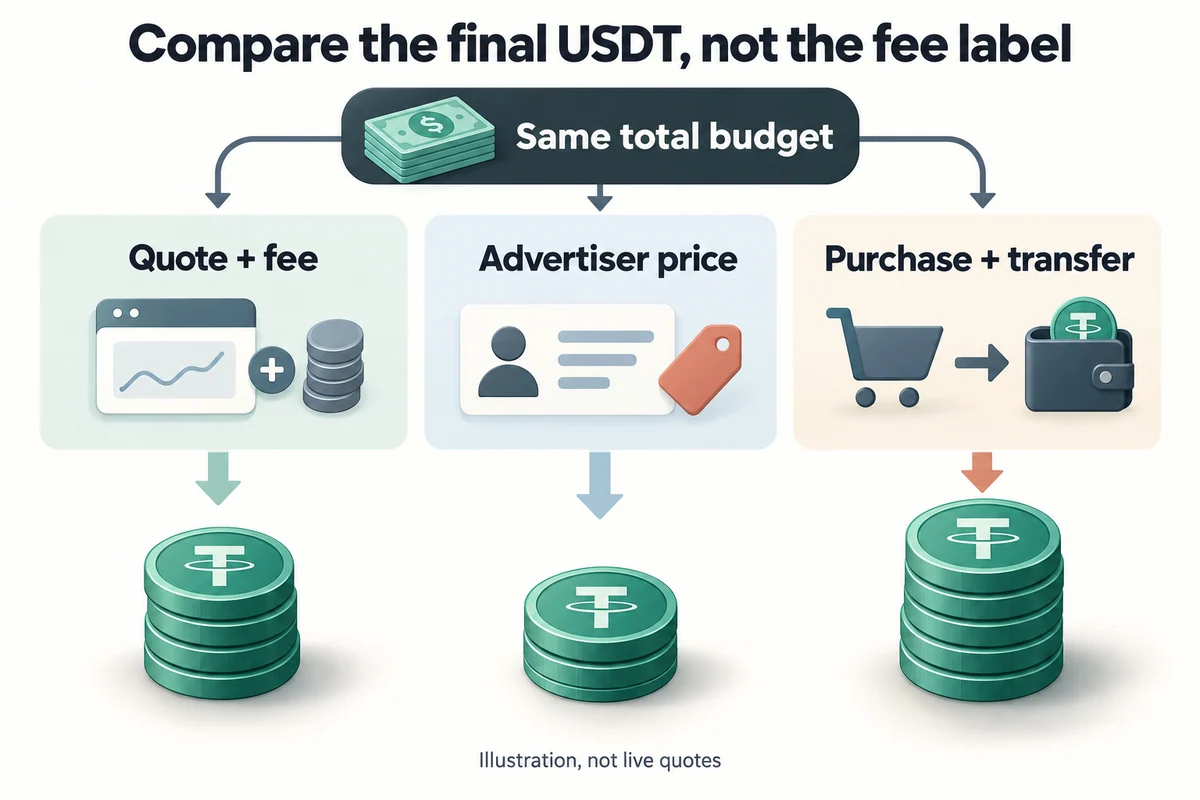
Cost against a chosen reference = (effective price ÷ reference price − 1) × 100%.
The reference must use the same fiat currency, asset and time. USDT need not trade at exactly one US dollar. The percentage is a comparison against that reference, not a guaranteed saving, loss or arbitrage opportunity.
Worked example: assumptions disclosed
Illustration only—not current Bybit quotes or advertised rates. Every row starts with a total 1,000 USD budget and an assumed 1.000 USD/USDT reference. No extra bank FX charge applies here. The fee conventions are explicit so the arithmetic can be reproduced; actual checkouts may differ.
| Hypothetical inputs | Net USDT | Cost vs reference |
|---|---|---|
| Card-style: assumed 2% added to principal; quote 1.005 | 1,000 ÷ 1.02 ÷ 1.005 = 975.51 | 2.51% |
| P2P-style: price 1.015; no additional fee assumed | 1,000 ÷ 1.015 = 985.22 | 1.50% |
| Provider-style: assumed 3% deducted from budget; quote 1.005 | (1,000 × 0.97) ÷ 1.005 = 965.17 | 3.61% |
| Fiat-balance-style: assumed 2 USD deposit cost; quote 1.008 | (1,000 − 2) ÷ 1.008 = 990.08 | 1.00% |
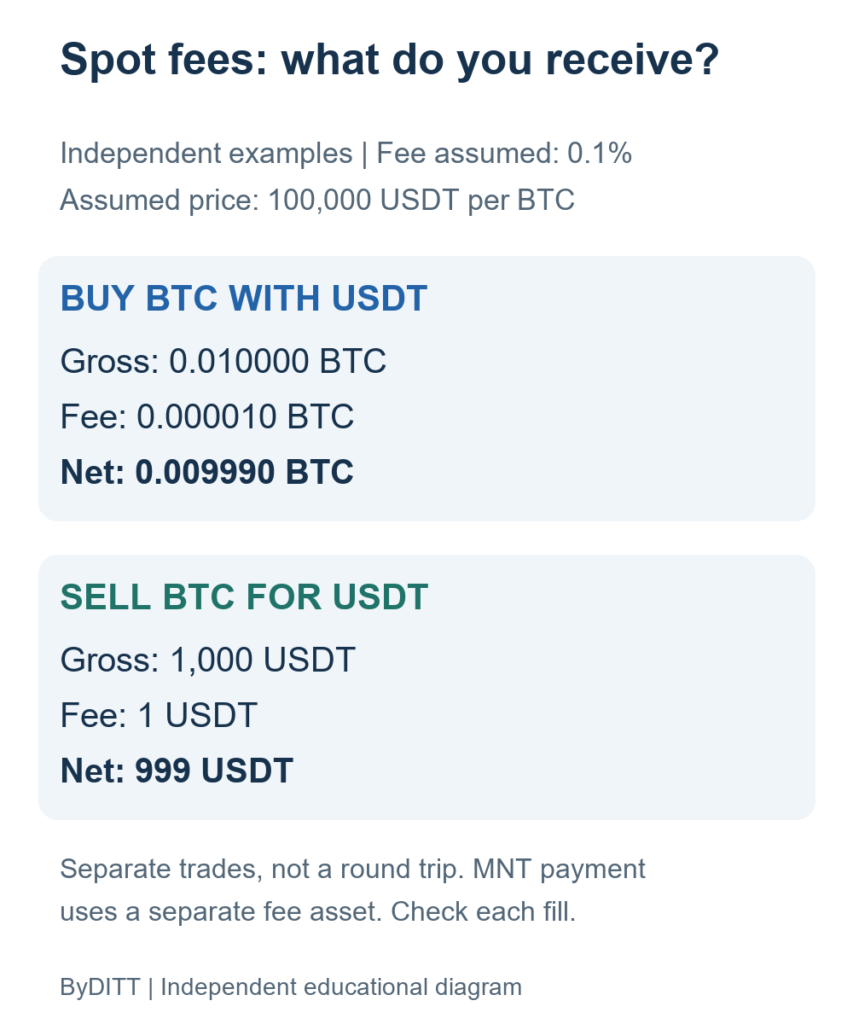
| Buy elsewhere then deposit: assumed 0.1% deducted on purchase at 1.000; 1 USDT withdrawal fee | (1,000 × 0.999) − 1 = 998.00 | 0.20% |
Amounts and percentages are rounded for display; comparisons use unrounded results. The assumed 2% card-style fee is a teaching input, not the published 2.10%/3.70% schedule. These rows demonstrate a method, not a ranking of today’s services. Different prices, payment charges, networks or eligibility can reverse the order.
Fee added versus deducted: two different formulas
Let B be the total budget, r the fee rate and q the quoted fiat price per USDT. A fee added to principal gives B ÷ (1 + r) ÷ q coins before other costs. A fee deducted as a percentage of the whole budget gives B × (1 − r) ÷ q.
For B = 1,000, r = 2% and q = 1.01, those results are 970.69 USDT and 970.30 USDT. Neither convention should be imposed on an unknown checkout. Use actual debit and receive fields, without subtracting an already included fee or spread again.
A five-field comparison record
- Route, provider and quote timestamp.
- Final debit currency and amount, including issuer/transfer charges.
- Final USDT receivable after included deductions.
- Any remaining purchase, conversion or transfer leg.
- Eligibility, timing and risks that make the route usable or unsuitable.
The best price among unusable routes has no decision value. Compare net amounts only after the fifth field has been checked.
4. A fixed fee matters more on a small transfer
An assumed 1 USDT fee is 1% of a 100 USDT transfer budget but 0.1% of a 1,000 USDT budget. This isolates one cost, excluding acquisition price and other charges. A fee that looks small on a large amount can make a test uneconomic or leave it below a minimum.
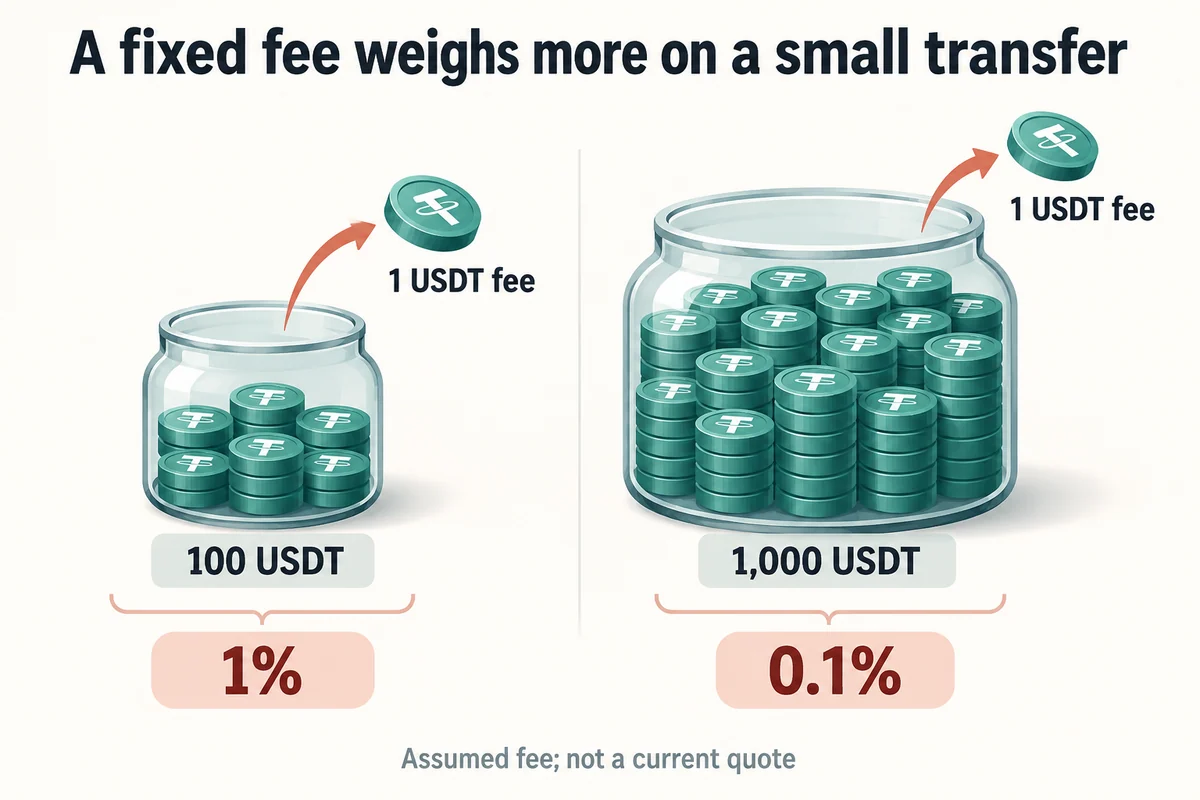
This is not a reason to increase a transfer amount. Compare the charge with your intended amount and consider a second fee for a test. Stop if minimums or risks do not fit; never choose an unsupported network simply because it appears cheaper.
5. Before payment—and when credit is delayed
Check total debit, final coins, expiry, provider, payment-account name and receiving account before committing. For a transfer, add asset, network, address, required memo/tag and minimum. Preserve order/transaction evidence privately; never publish full card details, identity documents, passwords, seed phrases or authentication codes.
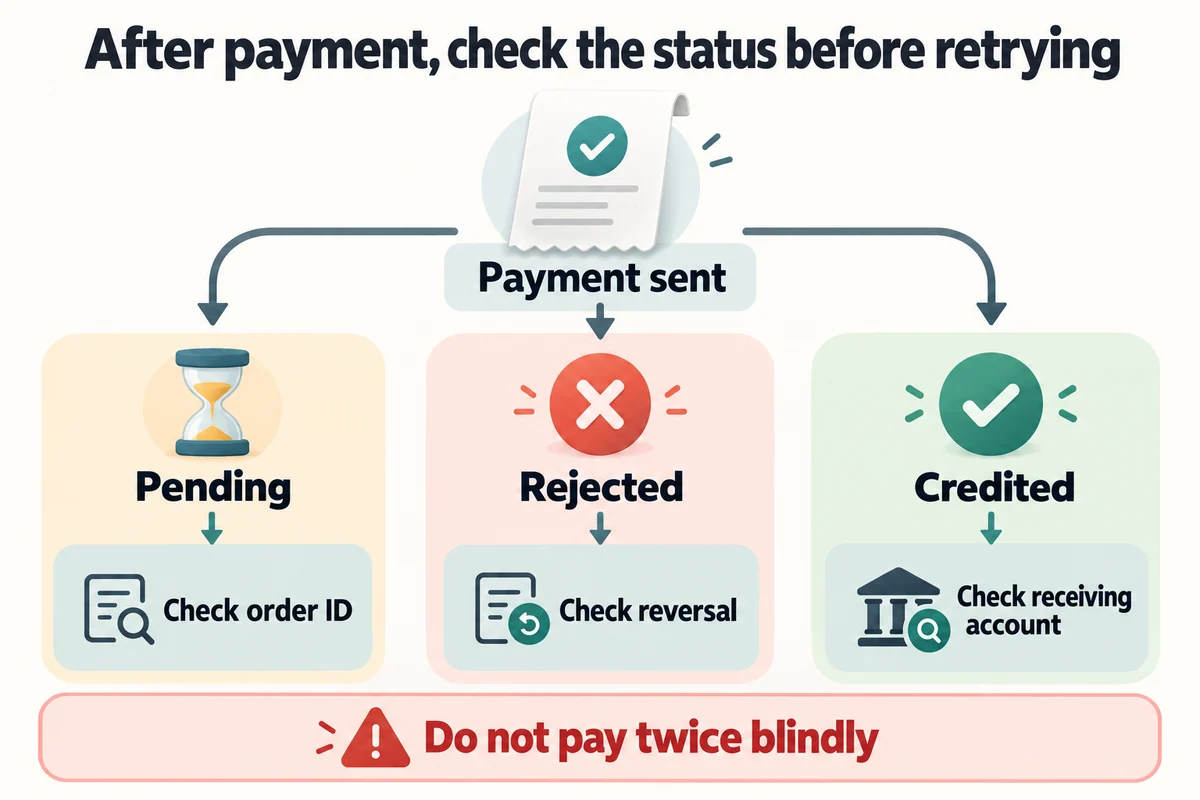
| Observed state | Check first | Do not assume |
|---|---|---|
| Method not shown | Currency, verification, region, main/subaccount and channel support | A false location or another person’s account makes it eligible |
| Card declined | Issuer message, authentication and pending authorization | Repeated unchanged attempts will fix it |
| P2P paid, not released | Existing order, payment evidence, chat and appeal route | Cancellation or off-platform payment is required |
| Provider charged, no credit | Provider ID, delivery status and receiving account | A debit proves USDT was credited |
| Crypto sent, no credit | Transaction ID, network, confirmations, minimum and review notices | A second transfer repairs the first |
| Credited but unavailable | Receiving account, available balance and hold/review notice | Credited, transferable and withdrawable mean the same thing |
Processing and refund windows depend on channel and failure state. The official procedure and FAQ describe channel-specific scenarios; there is no universal delivery promise here. Use the applicable order instructions and official support, not an unsolicited contact offering to “unlock” funds.
6. Frequently asked questions
What is the cheapest way to buy USDT on Bybit?
No route is always cheapest. Compare total fiat debited divided by net USDT receivable for available methods at the same time. A lower platform fee can be offset by a worse quote, issuer charge, fixed withdrawal cost or another conversion.
Is depositing USDT the same as buying it?
No. A deposit moves existing assets. Include purchase and transfer costs if buying elsewhere first. If you already own the USDT, distinguish its historical acquisition cost from the incremental cost of moving it.
Does zero P2P fee mean zero purchase cost?
No. The advertiser price and payment-provider costs remain relevant, and the current currency-specific schedule contains fee exceptions. Verify currency, role and KYC conditions rather than relying on a general zero-fee slogan.
Is a bank-card purchase fee a Bybit Card spending fee?
No. One purchases crypto with an external bank card; the other spends a balance through a different card product. Their eligibility and fee schedules are separate.
Does BYBITDC reduce all purchase, P2P and network costs?
This article makes no such claim. A code is not evidence of a provider discount, bank FX waiver, P2P price improvement or free blockchain withdrawal. Check actual account terms separately from the funding calculation.
Can readers in any country use this English guide’s routes?
English content does not establish availability or local authorization. Check provider restrictions and your local rules. Do not infer eligibility from a working page or bypass restrictions.
7. Optional affiliate reference and conflicts of interest
The approved ByDITT affiliate identifier is BYBITDC. For readers legally eligible to access the relevant service, this Bybit page with code BYBITDC (affiliate link) is a disclosed reference, not a recommendation to register or fund an account. Check the destination, displayed code and actual terms. No fixed discount, lifetime benefit or bonus is promised; the link does not change the calculations.
ByDITT may receive compensation. That interest is separate from the comparison. Neither a code nor KYC removes market, custody, counterparty, payment-reversal, regulatory or transfer risks. USDT can lose its peg and is not a substitute for an insured bank deposit. This is general education, not investment, legal or tax advice.
Official sources and verification notes
Checked October 18, 2026. A document’s update date is not automatically the effective date of every condition. The card schedule was marked updated October 13, the P2P schedule July 28, the purchase procedure September 19, its FAQ September 28 and the restricted-country page October 16. Account and provider conditions can change.
- Bybit: One-Click Buy procedure
- Bybit: One-Click Buy FAQ
- Bybit: currency-specific P2P fees
- Bybit: P2P verification FAQ
- Bybit: bank-card purchase fee schedule
- Bybit: bank-card payment FAQ
- Bybit: funding-method overview
- Bybit: general fee overview
- Bybit: restricted jurisdictions
- Korea FSC: unregistered-business and referral-risk notice, October 13, 2026
Method and limitations: The same-budget arithmetic is independent ByDITT analysis using declared inputs. No live checkout, card purchase, P2P trade or blockchain transfer was performed. All important image concepts and numbers are also in accessible text. No search ranking, AI citation, saving or successful transaction is guaranteed.