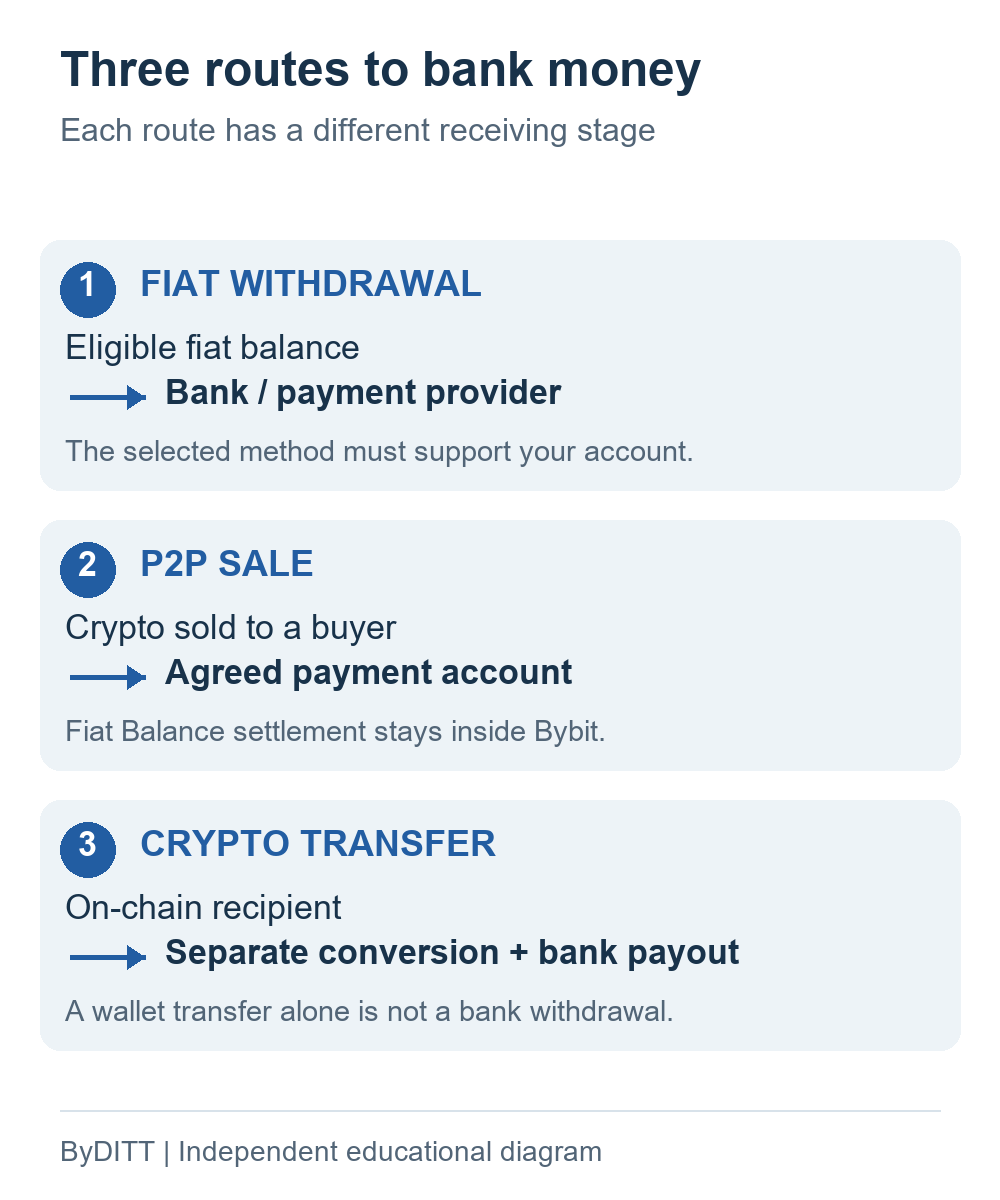
A Bybit bank withdrawal is possible only when your account supports the fiat currency, payment method and receiving account involved. A crypto withdrawal sends coins to a blockchain address, while a P2P sale exchanges crypto with another user under a selected payment method. To compare these routes, check where the money actually lands and what remains to be done before it reaches your bank.
Official sources checked: . Availability, fees and verification requirements can change. This is an independent ByDITT explanation, not a transaction quote or confirmation of your eligibility.
Which route can put money in your bank account?
Start with the destination, not the word “withdraw.” Write down the bank account, the currency it accepts and the service that would send the payment. Then work backwards to the balance you currently hold. USDT is a crypto asset; having USDT does not itself mean you hold withdrawable USD or that your bank accepts crypto.
| Route | What happens | Unresolved bank step |
|---|---|---|
| Fiat withdrawal | Eligible fiat is paid out through the selected channel. | Confirm that the method pays your accepted bank account or provider account. |
| P2P sale | A buyer pays using the order’s agreed payment method. | Confirm the destination. A Fiat Balance payment stays inside Bybit. |
| Crypto transfer | Crypto moves to a supported external address. | A separate eligible service must convert it and arrange the bank payout. |
Route 1: check whether fiat withdrawal is available to you
Bybit’s fiat guide lists currency and payment-channel conditions separately. Some methods require a previous deposit from the relevant account; others permit account linking or verification during withdrawal. The same currency can have more than one provider with different conditions. Read the row for your actual method rather than applying one provider’s requirements to every withdrawal in that currency. See Bybit’s fiat withdrawal guide.
Use this order for your own check:
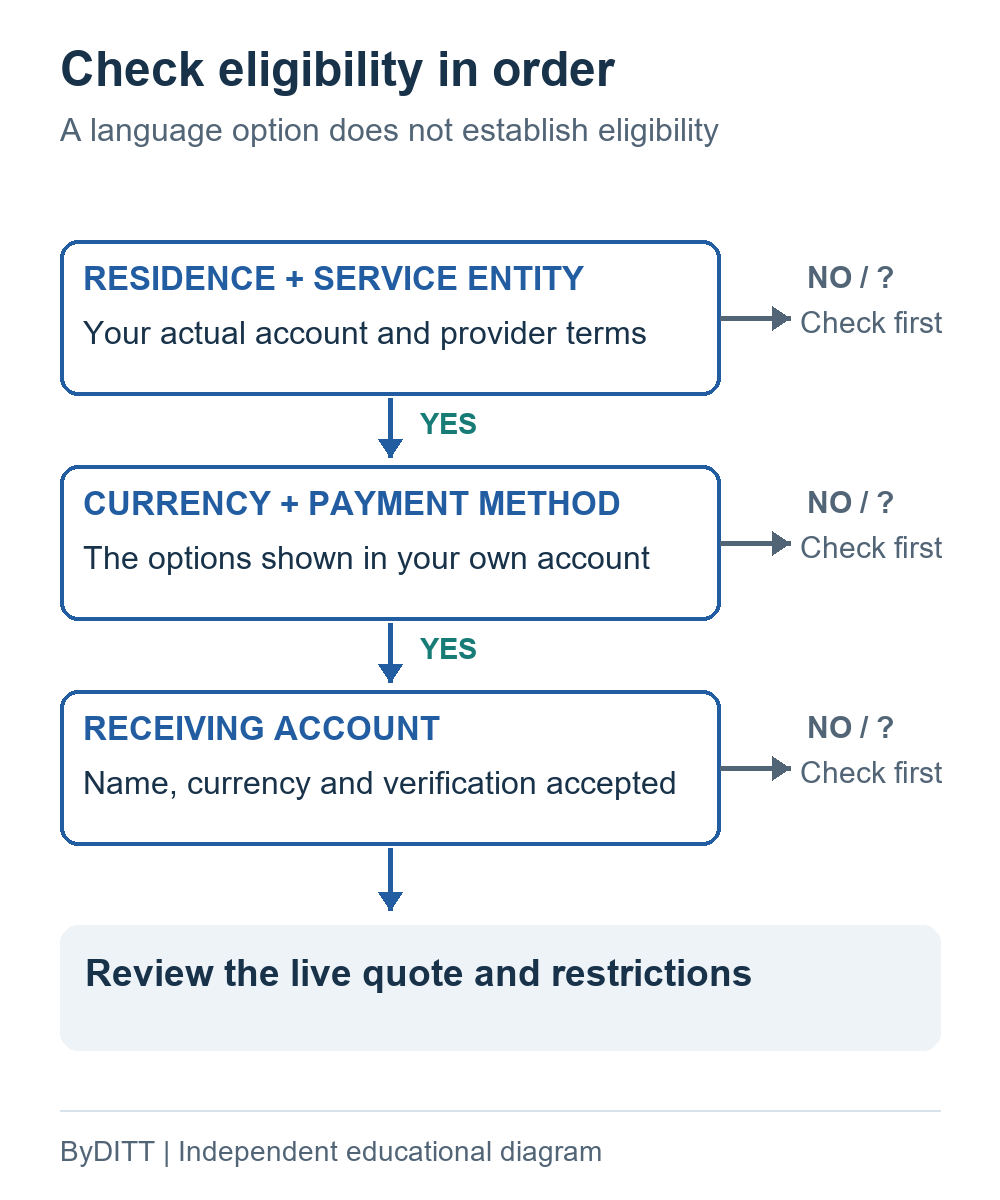
- Residence and service entity: identify which Bybit service and payment-provider terms apply to your actual account. A translated page or a currency mentioned in an article is not evidence that you are eligible.
- Live options: in the app, open Assets → Withdraw → Fiat and inspect the currencies and methods offered to your account. The website also provides a Fiat Withdrawal page.
- Receiving account: check the beneficiary details, supported bank or provider, accepted currency and any verification requirements.
- Order preview: record the amount, fees, limits, estimated processing time and any unresolved restrictions before submitting.
Bybit’s fiat withdrawal FAQ points users to the live withdrawal page for supported currencies, fees and method-specific information. It also states that a successfully submitted fiat withdrawal request cannot be canceled. Treat the final confirmation as a material step, not as a harmless test of availability.
Does your bank account pass all three checks?
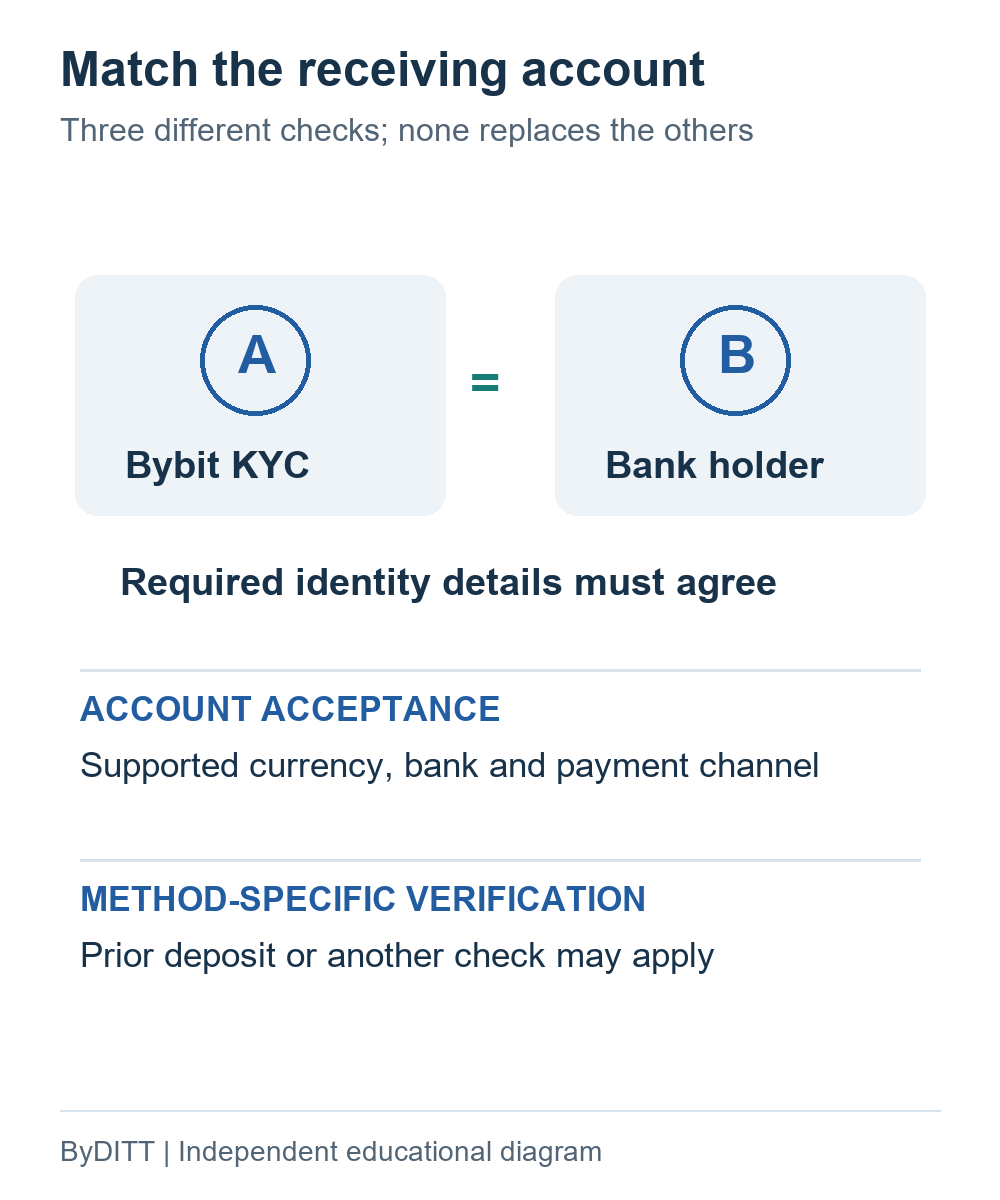
Identity matching, account acceptance and verification are separate questions. A correctly spelled name does not prove that a bank accepts the payment channel. Conversely, a supported bank does not remove a provider’s requirement to verify the account.
- Identity: use your own receiving account and check the required name or tax-identifier details against the verified information.
- Acceptance: confirm the account can receive the selected currency and type of payment. Ask the receiving institution about any conditions it imposes.
- Verification: follow the selected method’s actual linking or deposit-verification instructions. Do not make an unnecessary deposit merely because another currency’s instructions require one.
The official guide and FAQ describe method-specific exceptions, including cases where selected users can verify a bank account while adding it. This article does not confirm direct KRW withdrawal or eligibility for a person residing in Korea. Neither Korean-language access nor a Korean bank account establishes that a particular Bybit service is available.
Route 2: distinguish a P2P bank payment from Fiat Balance
In a P2P sale, the payment method is part of the order. Bybit’s P2P selling instructions require the receiving bank-account name to agree with the registered name. For an external payment, independently verify that the money has arrived in your own available balance before releasing crypto; a buyer’s message or payment screenshot is not that verification.
There is a distinct P2P Fiat Balance method that settles in Bybit Funding Accounts. That can produce fiat inside Bybit, but it does not itself credit your bank. A further supported fiat withdrawal would still be needed. Check the actual order’s payment method rather than assuming every P2P sale sends money off the platform.
Nor should “P2P” be read as “no total cost.” Bybit’s dedicated P2P fee schedule varies charges by currency, participant or advertisement conditions, and payment-provider charges may also apply. The offered exchange price is another input. Compare the final receiving amount and the specific fee treatment shown for the order.
For the detailed payment checks and appeal workflow, use our Bybit P2P guide to fees, payment safety and disputes. This route comparison does not replace those checks or establish that P2P is suitable or available in your jurisdiction.
Route 3: an on-chain transfer needs a separate bank payout
A crypto transfer can be one stage of a cash-out plan, but the receiving service must independently accept your account, the asset and the exact network. Confirm its bank-payout eligibility before transferring coins. A supported deposit address alone says nothing about your ability to withdraw local money from that destination.
Bybit’s on-chain withdrawal instructions show network-specific fees and minimums in the withdrawal form and note that some assets require a memo or tag. Account checks, blockchain confirmation and destination credit are separate from any later conversion and bank transfer.
Keep the comparison focused on the full route: crypto leaving Bybit, crypto actually credited at the destination, conversion proceeds there, then the final bank amount. Do not compare only a network fee with a fiat payout fee; the two quotes may cover different parts of the journey. Our Bybit deposit and withdrawal guide covers the network and net-crypto calculations in detail.
Compare the final bank credit, not just the withdrawal fee
The following is ByDITT’s independent accounting framework. It is not a current Bybit quote and does not rank the three routes by price. Use one final currency, one starting amount and comparable quote times. A lower visible withdrawal charge can be offset by a less favorable conversion quote or a later charge.
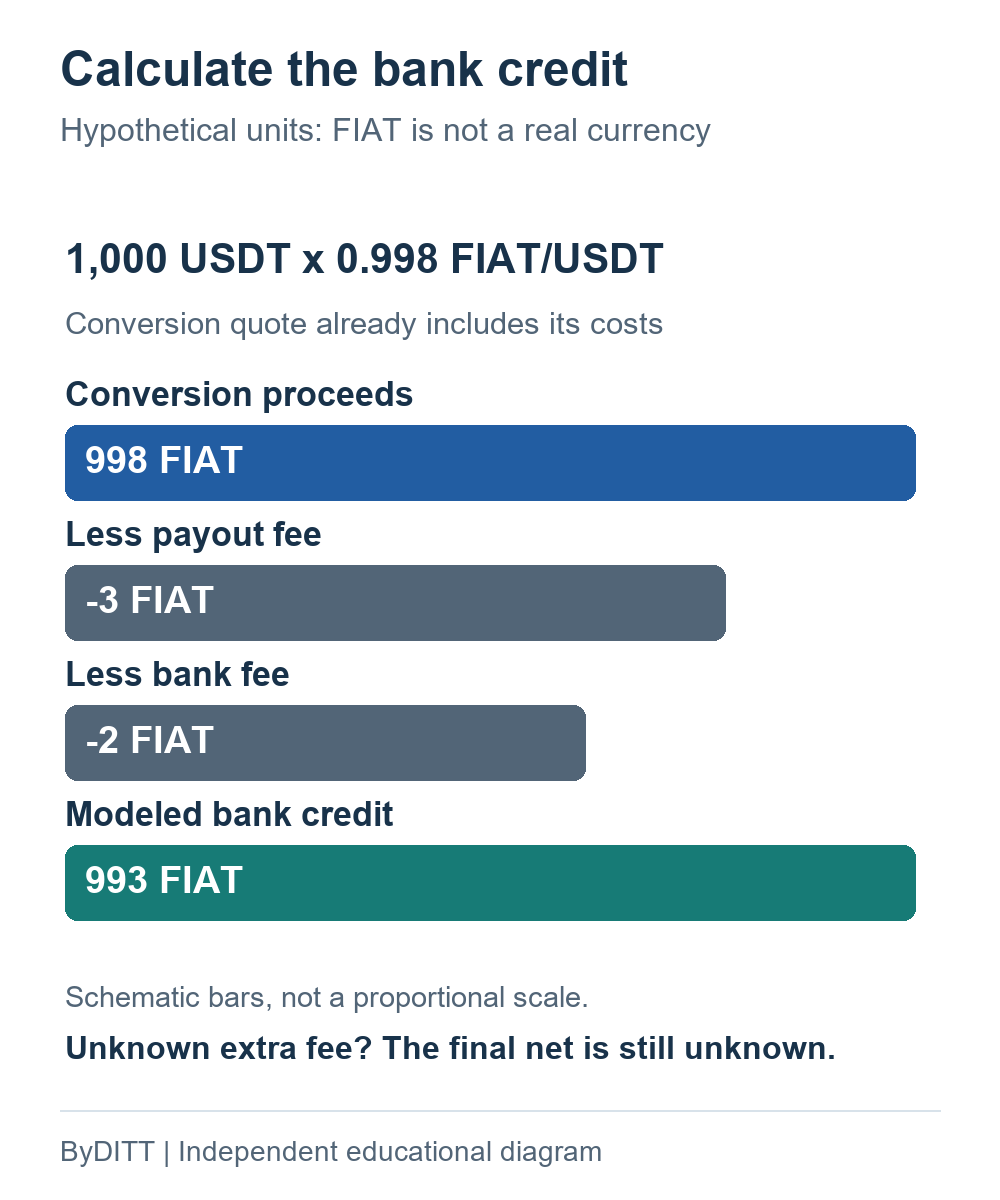
Modeled bank credit = conversion proceeds − payout charges − intermediary or receiving charges not already included.
For a crypto-transfer route, first establish how much crypto the destination would actually receive under the displayed deduction method, then apply its conversion quote. For a P2P route, use the order’s actual receiving amount and fee treatment. Never subtract a fee twice if the quoted proceeds are already net of that fee.
| Input or stage | Assumption | Result |
|---|---|---|
| Starting crypto | 1,000 USDT | 1,000 USDT |
| Conversion | 0.998 FIAT per USDT, including conversion costs | 998 FIAT |
| Payout charge | 3 FIAT, not included above | 995 FIAT |
| Receiving charge | 2 FIAT; assume no other charges | 993 FIAT |
The arithmetic is 1,000 × 0.998 − 3 − 2 = 993 FIAT. Every rate and charge in this example is invented. If an intermediary fee is unknown, 993 FIAT is only the subtotal under the stated assumptions; the final net remains unknown. Entering zero for an unverified charge would make the comparison look more precise than the evidence supports.
For a useful comparison record, keep the quote time, amount debited, amount promised at the destination, currency, included fees and unknown charges together. After settlement, compare that record with the actual bank credit. That shows where a difference arose without assuming every shortfall was a Bybit withdrawal fee.
“Completed” and “in my bank” are different observations
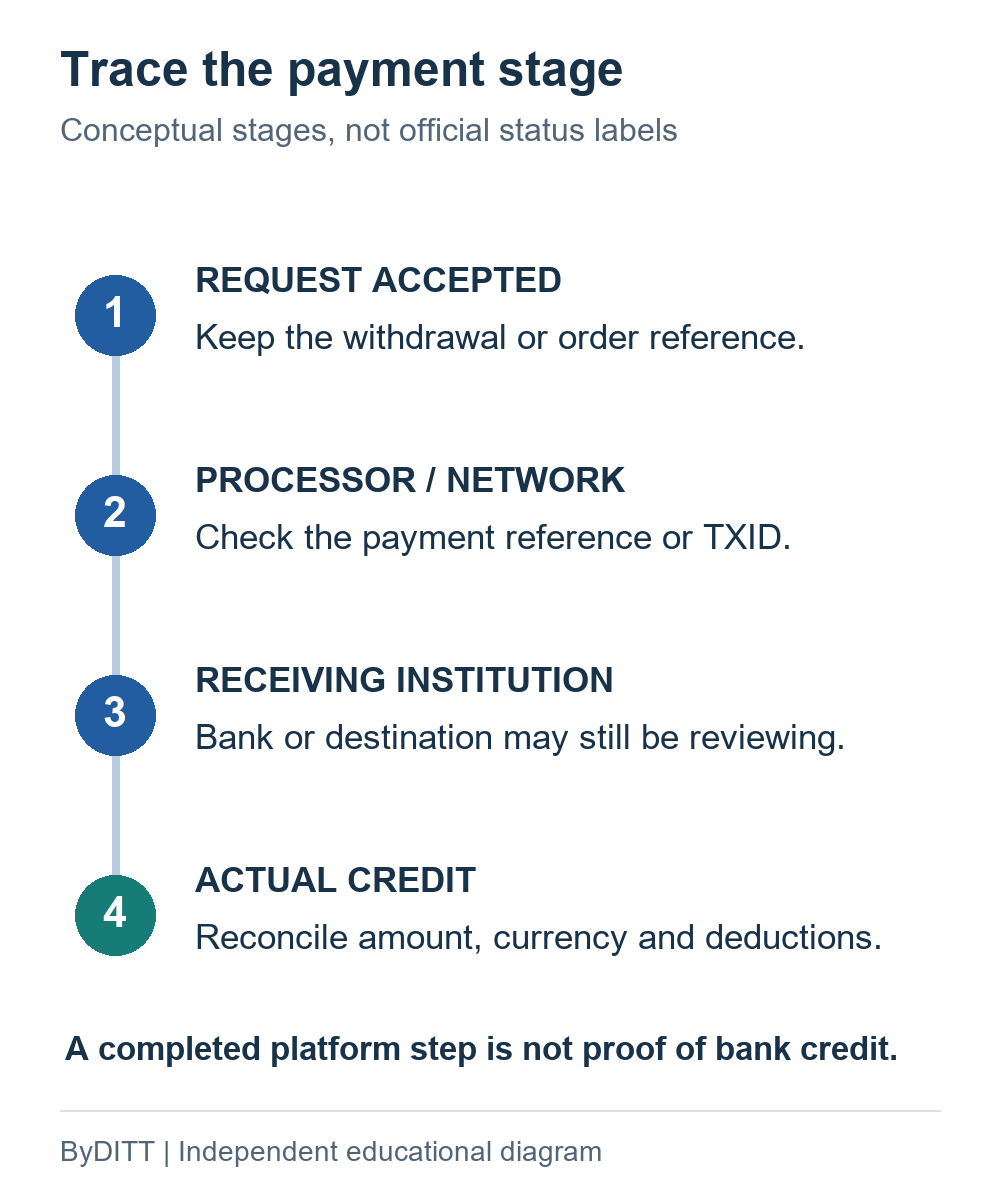
A status belongs to a particular system. Bybit’s fiat guide explains that its successful withdrawal stage can still be followed by bank or payment-provider processing. Do not apply a crypto withdrawal status definition to a fiat order, or treat a buyer’s payment notification as bank confirmation.
| Route or stage | Useful reference | What to establish |
|---|---|---|
| Fiat payout | Withdrawal order and provider payment reference | Whether the payment was submitted, returned or received by the bank |
| P2P payment | P2P order, in-platform chat and your actual payment-account record | Whether the agreed payment is genuinely available |
| Crypto leg | TXID, network and destination deposit record | Whether the intended destination credited the crypto |
| Later bank leg | Destination service’s payout reference and bank credit | Whether the separate conversion and bank payout completed |
This evidence map is ByDITT’s organizational tool. A TXID helps investigate a blockchain transfer; it cannot prove that an unrelated bank payout arrived. Keep sensitive statements and account details private, and provide only the necessary records through the verified support channel for the affected stage.
If a submission screen times out, inspect the existing order history before submitting again. If a payment is delayed, compare its stated processing estimate and current status with the receiving institution’s record. Describe the missing stage, amount, currency and reference when contacting support. See our Bybit deposit and withdrawal troubleshooting guide for a broader missing-funds checklist.
Questions to resolve before confirming
Can I withdraw USDT straight to my bank account?
A standard crypto withdrawal requires a supported blockchain destination. Bank money requires a supported sale or conversion and a payment route to the bank. Identify both steps and the service responsible for each; do not put bank-account details into a wallet-address field.
Is a previous bank deposit always required?
No universal rule covers every method. Follow the verification shown for your currency, provider and account. The official fiat guidance includes prior-deposit requirements as well as other verification paths for selected methods or users.
Which route is cheapest or fastest?
This cannot be determined from the route name. Compare eligible live quotes that cover the same final currency and amount, include unresolved costs, and distinguish estimated processing from actual receipt. An unavailable route is not a meaningful price alternative.
Does a referral or fee code change bank-withdrawal eligibility?
This guide has no verified basis for treating a referral code, including BYBITDC, as proof of bank-payout eligibility or a reduction in bank, provider or network charges. Trading-fee terms and bank-payout terms need separate verification. No referral link is needed to perform the checks described here.
Sources, editorial independence and risks
ByDITT is an independent educational and affiliate website, separate from Bybit.com. ByDITT may receive compensation through affiliate links elsewhere on this site, creating a potential conflict of interest. This article contains no affiliate registration link and does not recommend opening an account, depositing or trading.
Crypto prices and stablecoin values can change, funds held with a platform or payment provider involve custody risk, and P2P introduces counterparty and payment-dispute risks. Bank acceptance, compliance reviews, service restrictions and applicable tax obligations can affect the outcome. If funds support a margined position, removing them may also affect account risk; the official on-chain guide specifically warns about UTA margin ratios. Verify your circumstances before any transfer.
The route comparison, accounting example and evidence map are ByDITT’s independent explanations. Official facts were checked on 14 October 2026 against the following documents; their displayed update dates differ from our check date:
- How to Withdraw Fiat Currencies on Bybit — displayed update 14 June 2026.
- FAQ — Fiat Withdrawal — displayed update 17 July 2026.
- P2P on Bybit: Fees Explained — displayed update 28 July 2026.
- How to Sell Crypto with P2P Trading — displayed update 2 September 2026.
- How to Use Fiat Balance for P2P Trading — displayed update 12 January 2026.
- How to Submit an On-Chain Withdrawal Request — displayed update 12 April 2026.